
01 · Audit
Every workflow, mapped.
Department-by-department audit. Every repeatable task, ranked by cost and frequency.

“49 use cases mapped across 7 departments. 18 agents structured. 11 deployed in the first engagement — from offer generation to BOM creation to service troubleshooting. Phased from quick wins to ERP integration over six months.”
Orient’s sales engineers were spending half-days hand-building branded customer quotations across four machine lines, with pricing logic, terms, and configurations buried across spreadsheets and email threads. Marketing was running on instinct. Prospects had no way to self-serve product information after hours.
We mapped every repeatable workflow across seven departments, deployed eleven production-grade Claude agents starting with a fully branded Offer Generator, codified the brand and pricing logic into a single knowledge base, and surfaced that same knowledge base to prospects through a customer-facing landing page and chat widget.
“Capability without structure is just a chat window. The structure is where the value lives.”
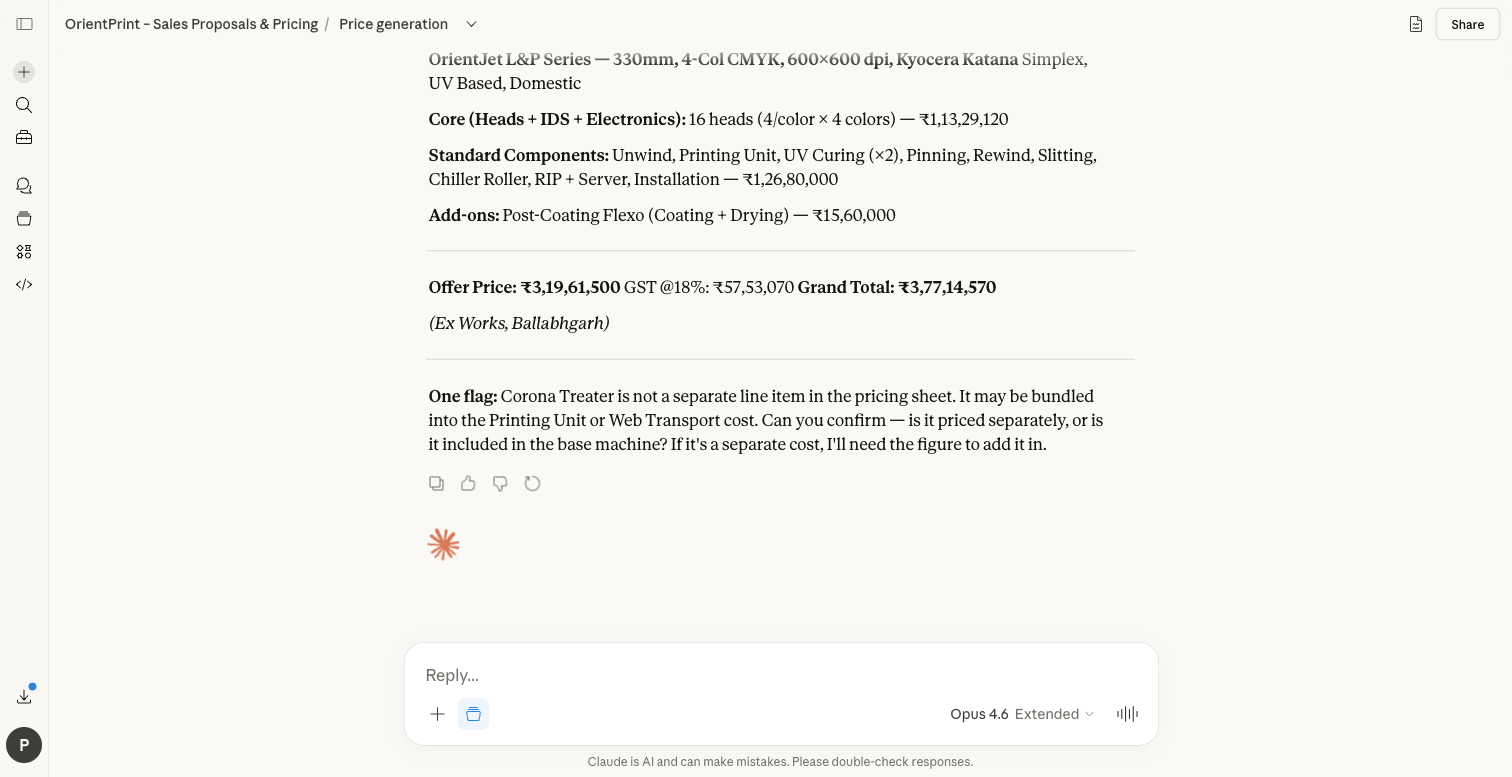
Eight branded machine spec docs. Three knowledge files for pricing logic, domestic terms, and international terms. One project instructions file that wires it all together. Not a clever prompt — a production-grade Claude agent trained on the entire sales surface of an eight-decade-old manufacturer.
Four-hour quotation work compressed to thirty minutes. Branded outputs that look like yours, not like a chatbot. An LLM that knows your products by name, your prices to the rupee, and your terms by version. And the safety to flag what it doesn’t know instead of inventing it.
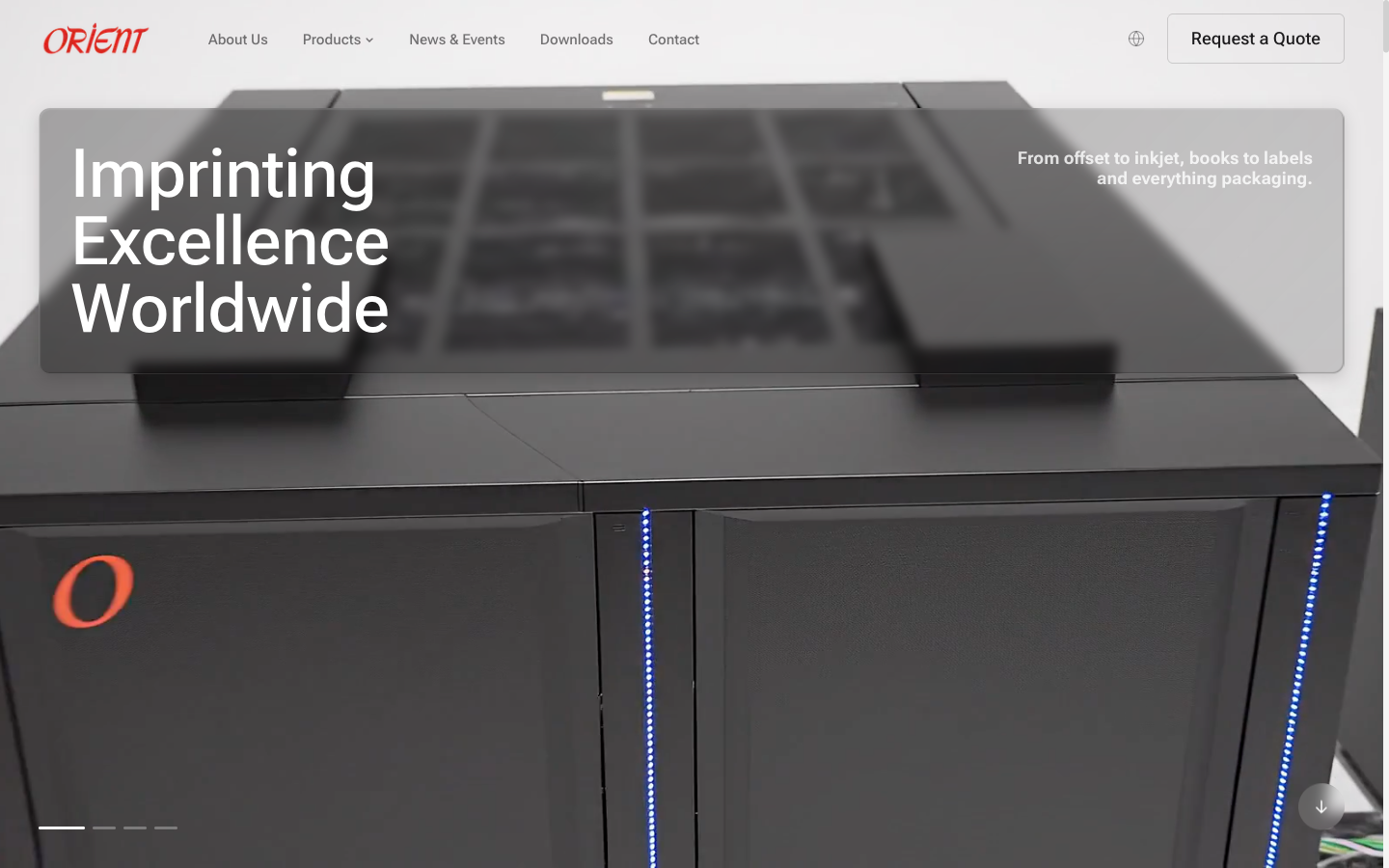
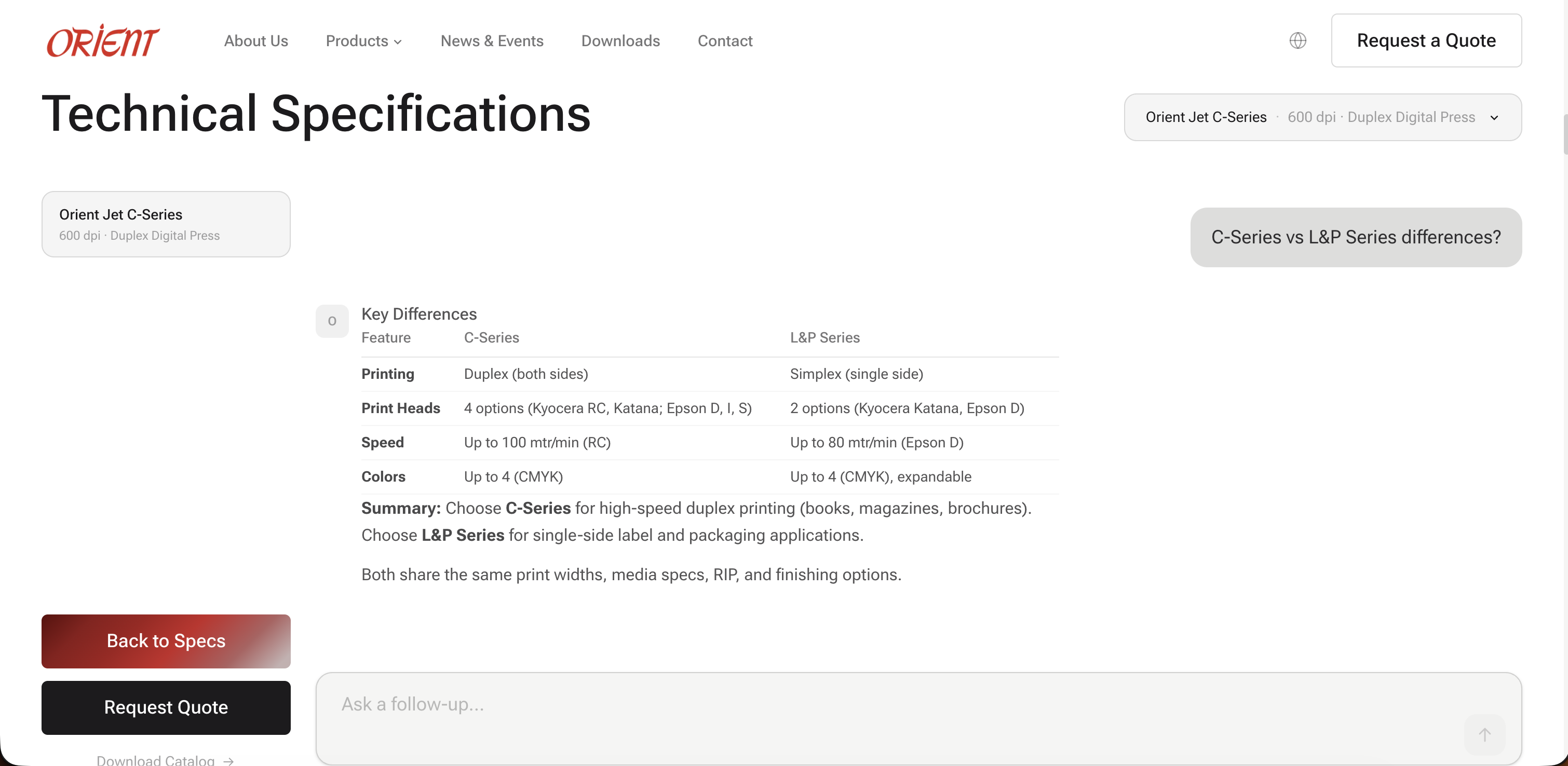
The same structured knowledge base that powers Orient’s internal Offer Generator also feeds the public site and the embedded chat widget. One place to update. Three places it shows up. Always consistent.
No hallucinated specs. No invented prices. Sub-second streaming responses across four machine lines, with guardrails for out-of-scope questions and pricing redirects.
Our clients get Claude's most powerful models. This is a lightweight preview — imagine what the full version does.
Agents as a Service
Every workflow we deploy becomes an AI agent. Your offer generator. Your MIS reporter. Your support desk. Your procurement analyst. Each one trained on your data, your rules, your voice.
Each agent costs a fraction of the employee doing the same work. One engagement with Settle. Every agent your business requires.
An engagement gives you every agent your business needs, custom-built around how you actually run. Want one agent today, or a consult to figure out what you need? The marketplace and a quick call are both there.
The gap isn't tools — it's deployment. Here's how we close it.

The model of record
Our POV · Three reasons
Tell it once — the pattern holds across every run. Zero prompt drift.
Says “I don’t know” before it invents citations, numbers, or policy.
MCP, function calling, structured workflows — production-grade agentic loops.
Not the only model we deploy. We pick what fits.
Talk to us about your stack
Field guide · Anthropic
Real enterprise deployments across research, finance, legal, and engineering.
claude.com/resources/use-cases
Attempt #1 and attempt #1,000 land identically.
Guardrails hold. Brand voice doesn’t drift.
SAP, HubSpot, Salesforce, Google Drive — via MCP.
In every engagement
Not a proposal. Not a deck. A company, operating on Claude — audited, built, trained, and handed over.
01 · Audit
Department-by-department audit. Every repeatable task, ranked by cost and frequency.
02 · Dashboard
03 · Instructions
04 · Knowledge
05 · Training
06 · Runbook
Our methodology
A four-phase approach for deploying Claude AI into mid-market businesses — Discovery, Architecture, Instruction Engineering, and Deploy & Settle. Every engagement runs the same playbook.
Client profiles
Profile · Manufacturing & industrial
Complex operations, multiple departments, heavy documentation overhead. We map your workflows, deploy Claude across teams, and train your people to use it.
Profile · Growing SMBs
Lean teams doing more than they should manually. We find the workflows where Claude saves the most time — and deploy those first, then layer the rest.
Voices from the field
I had the app in 2 days. It would have taken 2 months before.
“Since I can think faster than I could build, my range of ideas has grown.”
I don’t see any limit anymore.
“My worry isn’t intentional harm but unexamined assumptions being scaled through automation.”
“A laptop crash wiped three months of work. I rebuilt my website in four languages within five weeks.”
I run a four-person shop. Since Claude, we’re winning tenders we couldn’t even have bid on before.
Settle AI is a full-stack AI agency that deploys Claude AI — Anthropic’s frontier model — into the actual workflows of manufacturers, professional services firms, and mid-market companies. Settle handles the full rollout: workflow discovery, instruction engineering, custom agent deployment, integrations, and ongoing optimisation. The company is also known as “Settle with AI”, which is where the domain settlewithai.com comes from. Settle AI is built specifically for 50–500-person companies that are too complex for a DIY AI tutorial but too lean to justify a Big Four consulting engagement.
Settle AI was founded in 2025 by Pranav Ambwani. Pranav holds a BS in Electrical Engineering from the University of Southern California and spent nine years in product and growth across B2B SaaS and fintech in Los Angeles before returning home to Delhi to start Settle AI. He writes about Claude AI deployment, instruction engineering, and the mechanics of running AI in production on the Settle AI blog and on Medium.
Settle AI is remote-first and operates globally. Engagements have been delivered across India, the United States, the United Kingdom, and continental Europe. The agency focuses on mid-market companies — 50 to 500 employees — across thirteen industries: manufacturing, healthcare, legal, finance, logistics, real estate, professional services, construction, education, retail, SaaS, hospitality, and nonprofit. Settle AI works asynchronously by default with synchronous working sessions at deployment checkpoints.
Claude AI is Anthropic’s AI assistant, purpose-built for long, complex reasoning and safe enterprise use. I chose to work exclusively with Claude because, after testing every major model in production business workflows, it consistently outperforms on the tasks that matter most: multi-step document generation, precise instruction following, and reliable output across hundreds of runs. At Orient Printing, for example, Claude handles everything from generating 8-page sales proposals with accurate pricing to troubleshooting industrial printing press issues from technical manuals. One model, deeply understood, produces better results than spreading across three or four.
Absolutely. My first client is a 79-year-old printing and packaging manufacturer with 20,000+ units installed across 50 countries. Not exactly a Silicon Valley startup. I mapped 49 use cases across their 7 departments and deployed 11 in the first engagement, covering offer generation, RFQ drafting, BOM creation, service troubleshooting, and vendor analysis. Traditional businesses often have the most to gain from AI because their workflows are repeatable, documentation-heavy, and largely unchanged for years. The offer generator alone cut document creation time from 4 hours to 30 minutes. That’s not incremental. It’s a step change in how the team works.
Large consulting firms charge enterprise rates, take months to deliver a strategy deck, and then hand you a PDF that your team has to figure out how to implement. I do the opposite. Working Claude agents ship in the first two to three weeks. Your team is using AI from week one, not waiting for a 200-page assessment to get approved. Settle is built specifically for companies with 50 to 500 employees, the ones too complex for a DIY YouTube tutorial but too lean to justify a Big Four engagement. Every agent I deploy comes with production-grade instructions, safety rules, and review gates. Not a strategy deck. Working tools.
Four phases. First, Discovery: I spend time with your team to audit every department’s workflows and identify where AI will have the highest impact. Second, Architecture: I build a prioritised rollout plan that groups use cases by workflow cluster, not department, because that’s what produces the best results. Third, Instruction Engineering: I write production-grade Claude agent instructions with safety rules, edge case handling, review gates, and knowledge file specifications. Fourth, Deploy and Settle: agents go live, your team gets trained, and I iterate based on real usage. Quick wins typically ship in the first 2–3 weeks. Deeper integrations with your ERP or CRM follow in subsequent phases.
Most teams see their first working Claude agent within 2 to 3 weeks. These are typically high-volume, low-complexity tasks like email drafting, document generation, or knowledge base Q&A. The full rollout depends on your scope and how many departments are involved. Orient Printing deployed 11 agents across 7 departments over about 6 months, but they were measuring time savings from month one. The key is starting with a quick win that proves the value, then expanding from there. I’ve found that once one department sees results, the others start asking when they’re next.
Claude connects to your business systems through MCP (Model Context Protocol), an open standard built by Anthropic specifically for this purpose. If your system has an API or structured data export, I can build a connector for it. I’ve built MCP connectors for ERPs like SAP, CRMs like HubSpot and Salesforce, document stores like SharePoint and Google Drive, email systems, and custom internal databases. The connector is a lightweight server that sits between Claude and your system, translating data in both directions. Most connectors take a few days to build and test. Once connected, Claude doesn’t just know about your business in theory. It can read real data, pull actual numbers, and write results back.
Not at all. I engineer the instructions so your team interacts with Claude in plain language, exactly the way they’d talk to a knowledgeable colleague. They don’t write prompts, configure settings, or understand anything about AI. They use structured Claude agents that I’ve built and tested specifically for their workflows. A sales engineer types in a customer name and product requirements, and gets back a formatted offer document. A procurement manager describes what they need, and gets a complete RFQ. The complexity is in the instructions I write, not in what your team has to do.
Yes. Claude is built by Anthropic, which leads the industry in AI safety research. Data sent to Claude via the API is not used for model training by default. Anthropic holds SOC 2 Type II certification and offers HIPAA-eligible plans for healthcare data. Beyond Anthropic’s security, every project I deploy includes explicit safety rules, review gates, and output boundaries written into the instructions. Claude won’t share data between departments unless configured to. It won’t fabricate information. It won’t take actions without human approval at checkpoints I define. Your proprietary processes, pricing, and customer data stay private.
Industry-specific deployment guides, honest comparisons against the alternatives, and long-form writing on Claude AI in production.
Manufacturing, healthcare, legal, finance, logistics, real estate, professional services, construction, education, retail, SaaS, hospitality, nonprofit.
Honest side-by-sides against Big Four consulting, DIY, ERP vendor AI, freelancers, and generic AI tools.
Instruction engineering, Claude Skills, MCP connectors, and the mechanics of running AI in production.
Who builds this

Pranav holds a BS in Electrical Engineering from the University of Southern California and spent nine years in Los Angeles before returning home to Delhi. He founded Settle AI in 2025 to deploy Claude AI across mid-market businesses end-to-end.
The Close
We take on a small number of clients each quarter. Tell us about the project and we'll let you know if it's a fit.